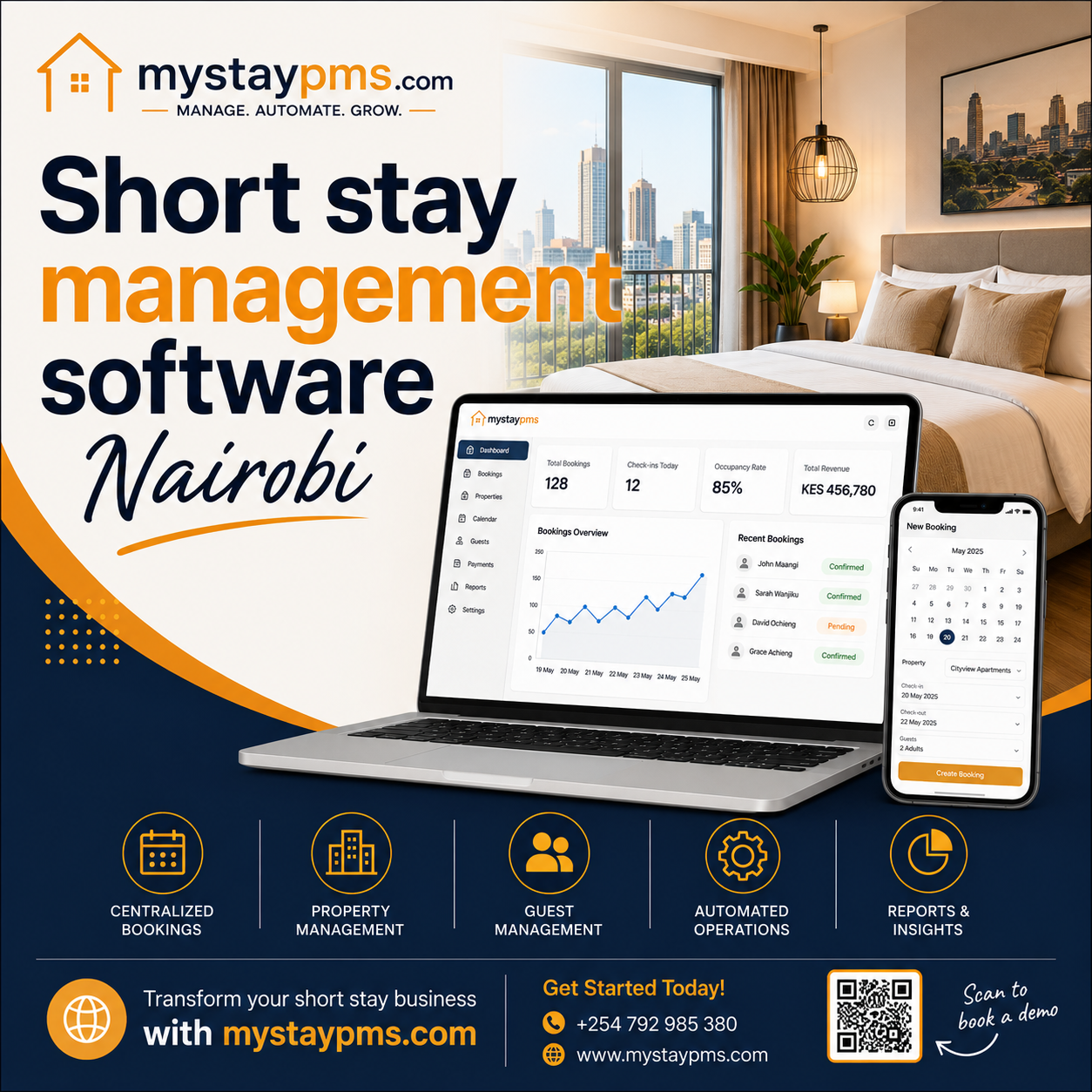
Short stay management software Nairobi is becoming increasingly important for property owners, Airbnb hosts, serviced apartment operators, furnished apartment managers, and hospitality businesses looking for a more organized way to manage short-term accommodation. Nairobi has developed into a major business, tourism, technology, and regional travel hub, creating demand for flexible accommodation options for both local and international guests. As the number of short-stay properties increases, managing bookings, guests, payments, housekeeping, maintenance, and property performance manually can become difficult.
Short-term accommodation is fundamentally different from traditional long-term property management. A long-term tenant may occupy a property for several months or years, while a short-stay guest could stay for only one night, several days, or a few weeks. This means the property can experience frequent arrivals and departures, requiring constant coordination between property managers, cleaners, maintenance teams, owners, and guests.
For a small operator with one apartment, managing these activities manually may initially seem manageable. However, once the portfolio grows to several apartments or multiple buildings, spreadsheets, notebooks, phone calls, and messaging applications can quickly become difficult to control. A centralized management platform can bring these activities together and provide a clearer view of the entire business.
The Growth of Short-Stay Accommodation in Nairobi
Nairobi offers a diverse accommodation market. The city attracts corporate travellers, tourists, expatriates, conference attendees, students, visiting professionals, families, and residents who need temporary accommodation. This creates opportunities for property owners who want to offer furnished apartments and other short-term accommodation options.
Areas such as Westlands, Kilimani, Kileleshwa, Lavington, Riverside, Parklands, Kilimani, South B, South C, and other established neighborhoods have become associated with furnished and serviced accommodation. Different locations attract different types of guests, and demand can change according to business activity, conferences, holidays, weekends, and seasonal travel.
As this market becomes more competitive, property owners cannot rely solely on having an attractive apartment. They also need efficient operations.
Guests expect quick responses, accurate booking information, smooth check-in procedures, clean rooms, reliable amenities, and prompt assistance when problems occur. Behind every successful guest experience is a series of operational processes that need to work correctly.
This is where technology becomes useful.
A modern short-stay operation can involve reservations, guest records, payment tracking, cleaning schedules, maintenance requests, property information, expenses, reports, and owner communication. Managing all these areas from separate systems creates unnecessary complexity.
A centralized platform can help bring them together.
What Is Short-Stay Property Management Software?
Short-stay property management software is a digital platform designed to help accommodation operators organize and manage their short-term rental operations.
Instead of maintaining separate records for reservations, guests, payments, housekeeping, and property information, a management platform can provide one centralized environment.
Depending on the software, operators may be able to manage:
- Properties and individual units
- Guest information
- Reservations
- Check-ins and check-outs
- Availability
- Payments
- Housekeeping
- Maintenance
- Expenses
- Revenue
- Owner statements
- Reports
- Staff activities
- Property performance
The purpose is not simply to replace a spreadsheet. The larger goal is to create a structured workflow where different parts of the business are connected.
For example, when a reservation is created, the relevant dates become part of the property’s booking calendar. When the guest checks out, the unit can be scheduled for cleaning. Once cleaning is completed, the property can be marked as ready for the next guest.
This type of workflow can reduce the amount of manual coordination required from the property manager.
Why Nairobi Property Managers Need Centralized Systems
Managing one property can be relatively straightforward. Managing several properties is a completely different challenge.
Imagine a property manager responsible for 15 furnished apartments.
On a normal day, there could be multiple guests checking in, several guests checking out, apartments waiting for cleaning, maintenance issues requiring attention, payments that need reconciliation, and new reservations arriving.
If the manager relies on WhatsApp messages, spreadsheets, notebooks, and separate booking calendars, information can become fragmented.
A centralized short stay management software Nairobi platform can help create a single source of operational information.
Instead of asking different employees for updates, a manager can view the relevant information from one dashboard.
This can help answer questions such as:
- Which apartments are occupied today?
- Which guests are checking in?
- Which guests are checking out?
- Which apartments need cleaning?
- Which properties are ready for arrival?
- Which reservations have outstanding balances?
- Which units are under maintenance?
- How much revenue has each property generated?
- Which properties have the highest occupancy?
- Which owners need financial reports?
The ability to answer these questions quickly can improve operational efficiency.
Centralized Booking Management
Bookings are one of the most important components of short-term accommodation management.
Every reservation affects property availability, guest communication, housekeeping, revenue, and operational planning. If booking information is not accurate, the consequences can affect the entire business.
A short stay management software Nairobi solution can provide a centralized booking calendar where property managers can monitor reservations across their portfolio.
Instead of checking individual calendars or searching through messages, managers can view upcoming arrivals and departures in one place.
A booking record can contain information such as:
- Guest name
- Guest contact details
- Property
- Unit
- Check-in date
- Check-out date
- Number of nights
- Number of guests
- Booking source
- Payment status
- Special requests
- Notes
- Booking status
This information can help staff understand what needs to happen before a guest arrives.
For businesses that receive reservations from multiple channels, centralized booking management can become even more important. The more sources a business uses, the greater the need for accurate availability information.
A well-organized calendar helps reduce the risk of scheduling mistakes and provides managers with a clearer overview of their inventory.
Avoiding Double Bookings
Double bookings can be one of the most damaging operational problems for short-stay businesses.
A property might appear available on one booking channel while already being reserved through another channel. If both reservations are accepted, the operator has to resolve the conflict, potentially disappointing one guest and damaging the business’s reputation.
A short stay management software Nairobi platform can help reduce this risk by centralizing reservation information and availability.
Depending on the system and its integrations, bookings from different sources may be synchronized or managed from a central calendar.
This allows the operator to see which dates are occupied, which are available, and which have been blocked for other reasons.
Avoiding double bookings is not just an administrative benefit. It can protect guest relationships, reduce refunds, minimize emergency relocation costs, and protect the reputation of the property.
For professional operators managing many units, accurate availability management should therefore be considered a fundamental requirement.
Guest Management From One Platform
Guest information is another important part of short-stay operations.
Unlike traditional rental management, short-term accommodation may involve a large number of guests passing through the same property throughout the year. This creates a significant amount of guest information that needs to be organized.
A short stay management software Nairobi system can provide guest profiles connected to reservation records.
A guest profile may include:
- Name
- Contact information
- Booking history
- Previous stays
- Special requests
- Notes
- Payment information
- Communication records
- Stay preferences
Having this information organized can help staff provide better service.
For example, a returning guest may have previously requested a particular type of room arrangement or highlighted a specific preference. If that information is available to authorized staff, the team can prepare for the guest more effectively.
Guest management also helps property managers understand their customer base.
They can identify repeat guests, corporate customers, frequent booking patterns, and other trends that may influence future marketing strategies.
Improving Guest Communication
Communication is one of the most visible aspects of hospitality.
Guests want answers quickly. They may ask about check-in times, directions, parking, Wi-Fi, payment procedures, house rules, nearby services, or property amenities.
If communication is disorganized, even a good apartment can produce a poor guest experience.
A short stay management software Nairobi system can help standardize important communication processes.
Managers can prepare standard information for:
- Booking confirmations
- Check-in instructions
- Property access
- House rules
- Wi-Fi details
- Parking information
- Checkout procedures
- Emergency contacts
- Payment reminders
Automation can reduce repetitive communication tasks while still allowing staff to respond personally to questions that require individual attention.
For example, a standard pre-arrival message can provide a guest with the necessary check-in information before they arrive. The manager can then focus on questions that require human assistance.
This can save time while creating a more consistent guest journey.
Housekeeping Management
Housekeeping is critical to short-stay accommodation.
A guest leaving a property today may be followed by another guest arriving tomorrow, or sometimes later on the same day. The property must therefore be cleaned, inspected, restocked, and prepared within the available turnover window.
A short stay management software Nairobi platform can help connect reservations with housekeeping schedules.
When a guest checks out, the system can help identify that the unit requires cleaning. The task can then be assigned to the appropriate member of the housekeeping team.
A housekeeping workflow might include:
- Guest checkout
- Cleaning assignment
- Bedroom cleaning
- Bathroom cleaning
- Kitchen cleaning
- Linen replacement
- Supply restocking
- Property inspection
- Maintenance check
- Final approval
- Unit marked as ready
This creates greater accountability.
Instead of simply sending a message saying, “Apartment 5 needs cleaning,” a structured system can show the assigned task, its status, and whether the property has been completed.
This becomes especially valuable when managing multiple buildings.
Managing Turnover Between Guests
Short-stay accommodation depends heavily on efficient turnover.
Every checkout creates a deadline before the next arrival. If cleaning takes too long or a maintenance issue is discovered at the last minute, the next guest could be affected.
A short stay management software Nairobi system can help managers coordinate turnover activities more efficiently.
The manager can view the day’s departures and arrivals and determine which units require immediate attention.
For example, if three guests are checking out in the morning and three new guests are arriving in the afternoon, the housekeeping team needs to know which properties have the highest priority.
A centralized schedule can make these priorities more visible.
It can also help managers identify operational bottlenecks. If certain units regularly take longer to prepare, management can investigate whether additional staff, supplies, maintenance, or process changes are required.
Maintenance Management
Maintenance issues are unavoidable in property management.
Air conditioning systems can fail, plumbing can develop problems, appliances can stop working, lights can require replacement, and furniture can become damaged.
In short-stay accommodation, resolving these issues quickly is particularly important because guests are usually staying for a limited period.
A short stay management software Nairobi platform can provide a structured way to record and track maintenance issues.
A maintenance record could include:
- Property
- Unit
- Reported problem
- Date reported
- Assigned technician
- Priority
- Status
- Repair cost
- Completion date
- Notes
This creates a history of maintenance activities.
Over time, property managers can identify recurring problems.
If the same water heater repeatedly fails, for example, repairing it every few months may be less efficient than replacing it. Historical maintenance records can provide useful information for making that decision.
Managing Property Expenses
Revenue is only one side of short-stay property performance.
Operators also need to understand expenses.
Common expenses can include:
- Cleaning
- Laundry
- Utilities
- Internet
- Maintenance
- Repairs
- Replacement supplies
- Staff payments
- Property management fees
- Platform commissions
- Security
- Consumables
- Furniture replacement
A short stay management software Nairobi platform can help organize these costs according to properties or units.
This is useful because a property that generates substantial revenue may still have weak profitability if its operating expenses are high.
Property-level expense tracking allows managers and owners to look beyond gross income.
For example, an apartment generating KSh 300,000 in monthly booking revenue may appear successful. However, if its operating expenses are significantly higher than another apartment with similar revenue, the second property may actually be more profitable.
Accurate expense information makes such comparisons easier.
Revenue Tracking
Short-stay operators need a clear understanding of how much money their properties are generating.
A centralized system can organize revenue by property, unit, reservation, booking source, or period.
A short stay management software Nairobi platform can make it easier to monitor revenue and compare performance.
Useful revenue information may include:
- Total booking revenue
- Revenue per property
- Revenue per unit
- Revenue by month
- Revenue by booking channel
- Paid amounts
- Outstanding balances
- Refunds
- Discounts
This information can support better decision-making.
Property owners can use it to evaluate investment performance, while professional managers can use it to prepare owner reports.
M-Pesa Payment Management
Payment management is particularly important for Kenyan short-stay operators.
M-Pesa is widely used for digital payments in Kenya, making it an important consideration for businesses that accept direct reservations and local guest payments.
A short stay management software Nairobi platform that supports local payment workflows can make it easier to associate payments with reservations.
For example, when a guest pays a deposit, the property manager needs to know which booking the payment belongs to and how much remains outstanding.
A structured payment record can show:
- Booking
- Guest
- Amount paid
- Payment date
- Payment method
- Balance
- Payment status
This reduces the need to maintain separate manual payment records.
It can also help with reconciliation when management needs to compare booking records with actual payments received.
Managing Direct Bookings
While online booking platforms can provide valuable exposure, direct bookings can also be important for short-stay businesses.
Direct bookings may come through a property’s website, phone calls, social media, referrals, corporate relationships, or returning guests.
A short stay management software Nairobi platform can help operators record these reservations alongside bookings from other sources.
This creates a complete picture of occupancy and revenue.
For example, a property manager might receive a reservation through a direct phone call. Instead of writing the information in a notebook and hoping to update the calendar later, the booking can be entered into the central system immediately.
The dates can then be reflected in the property’s availability.
This reduces the chance that another reservation will accidentally be accepted for the same dates.
Managing Multiple Properties
Portfolio management becomes more complicated as the number of units increases.
An owner with one apartment has one calendar, one property profile, and one operational workflow.
An operator with 30 apartments may have multiple buildings, different property owners, various unit types, several cleaners, maintenance contractors, and hundreds of annual reservations.
A short stay management software Nairobi system can provide the structure needed to manage this larger operation.
Properties can be organized according to:
- Building
- Location
- Owner
- Unit
- Property type
- Number of bedrooms
- Status
- Availability
This can make it easier to move from individual property management to portfolio-level management.
Managers can also compare properties and identify which units are performing well and which may require attention.
Property Performance Reporting
Data is valuable when it can be converted into useful information.
A modern property manager should be able to evaluate the performance of individual units rather than simply looking at the total revenue of the entire portfolio.
A short stay management software Nairobi system can support reports related to:
- Occupancy
- Revenue
- Expenses
- Bookings
- Average stay length
- Guest activity
- Maintenance
- Cleaning
- Payments
These reports can help identify trends.
For instance, one apartment may have strong occupancy but relatively low revenue because its nightly rate is too low. Another may have a higher rate but more vacant nights.
Looking at both occupancy and revenue provides a more complete picture.
Making Better Business Decisions
One of the major advantages of using technology is improved decision-making.
Property managers often need to decide whether to adjust pricing, renovate a unit, purchase new furniture, increase marketing, change cleaning processes, or invest in another property.
Without reliable data, these decisions can become based primarily on assumptions.
A short stay management software Nairobi platform can provide information that supports more informed decisions.
If a property has declining occupancy, the manager can investigate the reason. If maintenance costs are increasing, historical records can help identify the source. If one unit consistently outperforms similar properties, management can examine what makes it successful.
Technology does not make these decisions automatically.
Instead, it provides the information needed to make them more intelligently.
Reducing Administrative Work
Administrative tasks can consume a large amount of time in short-stay management.
Managers may spend hours updating calendars, calculating balances, responding to routine questions, preparing reports, checking cleaning schedules, and organizing expenses.
A short stay management software Nairobi platform can automate or simplify many repetitive activities.
This can allow managers to spend more time on activities that require judgment and human interaction.
For example, instead of manually preparing a monthly property report from several spreadsheets, a centralized platform may provide the relevant information in a structured report.
Instead of repeatedly asking cleaners whether a unit is ready, managers can check the status of assigned tasks.
Instead of searching through multiple conversations to find a reservation, the booking information can be stored in the system.
These small improvements can have a significant cumulative impact.
Why Short-Stay Software Should Be Designed for Local Operations
Not every international property management platform will necessarily fit the requirements of a Nairobi-based business.
Local operators have specific considerations, including payment methods, currency, local guest expectations, property locations, staff workflows, and communication practices.
A suitable short stay management software Nairobi solution should therefore be evaluated according to the realities of the local market.
Operators should consider whether the platform can support Kenyan Shillings, local payment workflows, multiple properties, local staff responsibilities, and the type of accommodation they operate.
The best system is not necessarily the one with the longest feature list. It is the one that solves the operational problems the business actually faces.
For a Nairobi short-stay operator, that could mean prioritizing booking management, housekeeping, payments, financial reporting, guest management, maintenance, and portfolio visibility.
Building a More Professional Short-Stay Business
The transition from manually managing a few apartments to operating a professional short-stay portfolio requires better processes.
Technology can support that transition.
A short stay management software Nairobi platform provides a structured environment where reservations, guests, properties, payments, housekeeping, maintenance, and financial information can work together.
This creates greater consistency across the business.
It also helps establish repeatable processes.
A new employee can understand the workflow more easily when tasks are documented in a system. A property owner can receive structured information instead of relying on informal updates. A manager can monitor operations without personally checking every apartment.
This is particularly important for businesses that want to grow.
Growth without systems can create chaos. Growth with organized processes can create a more scalable business.
What Property Owners Should Look for Before Choosing Software
Before investing in a management platform, property owners should evaluate their actual operational requirements.
The first question should be: What problems are currently taking the most time?
For some operators, the biggest issue may be bookings. For others, it may be housekeeping, payments, owner reporting, or guest communication.
Once the major challenges are identified, the business can compare available systems against those requirements.
A short stay management software Nairobi platform should ideally provide an intuitive interface, reliable booking management, property records, guest management, payment tracking, financial reporting, and operational workflows.
Businesses should also consider:
- Ease of use
- Number of users supported
- Property limits
- Mobile accessibility
- Data security
- Reporting capabilities
- Payment integrations
- Booking integrations
- Customer support
- Scalability
- Pricing structure
- Training requirements
Choosing software based only on price can create problems later.
A cheap system that does not support the business’s workflow may eventually cost more through manual work, errors, and operational inefficiencies.
The goal should be to select a platform that provides measurable value to the operation.
Preparing for Growth in Nairobi’s Short-Stay Market
Short-term accommodation management is becoming more operationally sophisticated.
Property owners are increasingly competing on more than location and appearance. Guest service, response time, cleanliness, reliability, availability, communication, and consistency all influence the overall experience.
This means management systems can become an important competitive advantage.
A short stay management software Nairobi solution can help operators establish processes that remain consistent as their portfolios grow.
Whether an owner manages one furnished apartment or a larger portfolio, the underlying principle remains the same: accurate information should be available when it is needed, tasks should be clearly assigned, and property performance should be measurable.
The more properties an operator manages, the more important these principles become.
A structured system can help transform short-stay management from a collection of daily administrative tasks into a coordinated business operation.
The next stage is to examine how these systems can improve specific areas such as occupancy management, pricing, guest retention, owner reporting, operational automation, and portfolio growth while maintaining a consistent service experience across Nairobi properties.
Streamlining Bookings, Operations, Payments and Property Performance
The short-term rental industry in Nairobi is becoming increasingly organized, competitive, and technology-driven. Property owners and accommodation operators are no longer managing only a few reservations from their phones. Many are handling multiple furnished apartments, serviced apartments, Airbnb units, corporate stays, direct bookings, housekeeping teams, maintenance requests, guest communications, and financial records at the same time.
For businesses operating in this environment, Short stay management software Nairobi can provide the centralized tools needed to coordinate these activities more efficiently.
Nairobi’s serviced-apartment market has a strong concentration in areas such as Westlands and Kilimani, with other important nodes including Nairobi CBD, Limuru Road, Kileleshwa, Upper Hill, and Thika Road. A 2025 Cytonn Research report placed Westlands and Kilimani at the top of its Nairobi Metropolitan Area serviced-apartment market-share breakdown, demonstrating the scale of accommodation activity in these locations.
This concentration creates opportunities for property owners, but it also increases competition. An attractive apartment may generate bookings, but keeping guests satisfied and maintaining profitability requires efficient management behind the scenes.
The Changing Nature of Short-Stay Property Management
Traditional property management is often centered around long-term leases, monthly rent collection, tenant records, and periodic maintenance. Short-stay accommodation operates on a different rhythm.
A guest might check in on Monday and leave on Thursday. Another guest may arrive later that same day. The apartment needs to be cleaned, inspected, restocked, and confirmed as ready before the next arrival.
The same process may happen repeatedly throughout the month.
This means managers have to coordinate several activities simultaneously:
- Reservations
- Availability
- Guest communication
- Check-in
- Check-out
- Housekeeping
- Linen management
- Maintenance
- Payments
- Expenses
- Guest records
- Property reporting
- Owner reporting
A Short stay management software Nairobi platform can connect these activities and give operators a central place from which to manage their portfolio.
This approach is increasingly relevant as Kenyan property technology platforms develop features specifically for short-term rentals. Existing solutions in Kenya promote booking calendars, multi-channel synchronization, guest communication, housekeeping workflows, payment tracking, and property-level reporting.
Managing Occupancy More Effectively
Occupancy is one of the most important indicators in a short-stay business.
A vacant apartment represents potential revenue that was not captured. However, simply trying to maximize occupancy without considering pricing and operating costs is not enough. Managers need to understand when properties are available, when demand is increasing, and which units are generating the strongest returns.
A Short stay management software Nairobi system can provide a visual availability calendar that shows reservations, blocked dates, arrivals, departures, and open inventory.
This gives managers a more accurate picture of the portfolio.
For example, a manager overseeing ten apartments could quickly identify:
- Apartments occupied today
- Apartments checking out today
- Apartments arriving tomorrow
- Units available for new reservations
- Units blocked for maintenance
- Units waiting for housekeeping
- Units that are ready for guests
Without a centralized calendar, this information may be spread across spreadsheets, messaging conversations, booking platforms, and personal notes.
A centralized system reduces the amount of manual checking required.
Managing Multiple Booking Channels
Short-stay businesses can receive reservations from multiple sources.
These may include:
- Airbnb
- Booking websites
- Direct website bookings
- Phone reservations
- WhatsApp enquiries
- Corporate clients
- Repeat guests
- Travel agencies
- Referrals
The challenge is keeping availability accurate across all these sources.
A Short stay management software Nairobi platform with channel-management capabilities can help operators centralize reservations and reduce the risk of conflicting bookings.
Some Kenyan short-stay platforms currently promote integrations and synchronization across Airbnb, Booking.com, VRBO, and direct reservations.
This type of functionality is particularly useful for operators managing several units.
Imagine receiving a booking for an apartment through an online platform while simultaneously receiving a direct WhatsApp reservation for the same dates. If the availability calendar is not updated quickly, the manager could accidentally confirm both reservations.
A centralized booking environment can help prevent this type of operational problem.
Improving Booking Accuracy
Booking errors can be expensive.
A simple mistake in a guest’s arrival date can affect housekeeping, payment collection, property availability, and other reservations.
A Short stay management software Nairobi solution can keep essential booking information organized.
A reservation record can contain:
- Guest name
- Contact information
- Property
- Unit
- Arrival date
- Departure date
- Number of nights
- Number of guests
- Booking source
- Rate
- Payment status
- Deposit
- Outstanding balance
- Special requests
- Booking notes
Having these details together means staff do not have to search through several systems whenever they need information about a reservation.
This can be particularly valuable when a business has several employees handling different responsibilities.
The reservations team can manage bookings, housekeeping can view departures and arrivals, finance can review payments, and property managers can monitor operational issues.
Dynamic Pricing and Revenue Opportunities
Short-stay accommodation does not always have to operate at the same nightly rate throughout the year.
Demand can change based on weekends, holidays, conferences, business travel, tourism, events, school holidays, and other factors.
This means pricing can become an important part of revenue management.
A Short stay management software Nairobi system may help operators organize different rates, minimum-stay requirements, date-based pricing rules, and other booking conditions.
Some modern short-stay platforms also advertise dynamic pricing capabilities designed to adjust rates according to demand.
For property owners, this can create a more structured approach to pricing.
Instead of charging the same rate every night, managers can analyze historical performance and adjust pricing according to expected demand.
For example, a property might have a standard weekday rate and a different weekend rate. During periods of unusually high demand, the operator may use another pricing strategy.
The important point is that pricing decisions should be based on the property’s market, operating costs, competition, demand, and overall revenue objectives.
Understanding Revenue Per Property
Total portfolio revenue can sometimes hide the performance of individual units.
A company may generate strong overall income while some apartments are underperforming.
A Short stay management software Nairobi system can provide property-level reporting so managers can evaluate individual units.
Useful measurements can include:
- Occupancy
- Booking revenue
- Average daily rate
- Number of nights sold
- Average length of stay
- Expenses
- Net income
- Booking source
- Cancellation activity
These figures can help managers compare properties.
For example, if two one-bedroom apartments are located in similar areas but one consistently generates more revenue, the operator can investigate why.
Potential factors could include:
- Better photography
- Better furnishing
- Faster guest response
- More competitive pricing
- Better reviews
- More amenities
- Better availability
- More effective distribution
Data gives the manager a starting point for that investigation.
Managing Housekeeping at Scale
Housekeeping becomes increasingly difficult as the number of short-stay units grows.
With one apartment, a host can call a cleaner directly. With twenty apartments, the same approach can create confusion.
The cleaner needs to know which units require attention, when they need to be completed, and which units have upcoming arrivals.
A Short stay management software Nairobi system can connect housekeeping tasks to reservations.
When a guest checks out, the property can automatically appear as requiring cleaning or be assigned to a designated staff member, depending on the system.
The housekeeping team can then work through scheduled tasks.
A task management process might show:
Apartment A: Checkout 10:00 AM — Cleaning required
Apartment B: Checkout 11:00 AM — Cleaning required
Apartment C: No checkout — Routine inspection
Apartment D: New arrival 2:00 PM — Priority cleaning
This is much easier to manage than relying on multiple phone calls.
Tracking Cleaning Completion
Knowing that a cleaner was assigned is not the same as knowing that the property is ready.
A Short stay management software Nairobi platform can help create a status-based workflow.
For example:
Pending → Assigned → Cleaning → Inspection → Ready
This gives the property manager greater visibility.
If a guest is arriving in two hours and the apartment is still marked as “Cleaning,” the manager knows that the unit requires attention.
If it is marked “Ready,” the team can proceed with confidence.
This simple workflow can improve coordination between housekeeping and reservations.
It can also create accountability because tasks are no longer based entirely on verbal instructions.
Inventory and Restocking
Short-stay accommodation requires regular supplies.
These can include:
- Toiletries
- Toilet paper
- Cleaning products
- Drinking water
- Kitchen supplies
- Laundry products
- Bed linen
- Towels
- Tissue
- Guest amenities
A guest arriving at an apartment without basic supplies can quickly develop a negative impression.
A Short stay management software Nairobi platform can support operational checklists and property workflows that help managers monitor turnover requirements.
Some short-stay management systems specifically include restocking as part of their turnover workflows.
This allows operators to establish standard procedures rather than depending on individual staff members to remember every item.
A checklist might require the cleaner to confirm:
- Towels available
- Bed linen replaced
- Bathroom supplies available
- Kitchen supplies available
- Water available
- Wi-Fi operational
- Appliances working
- General cleanliness confirmed
Standardization can improve consistency across properties.
Managing Maintenance Requests
Maintenance problems can affect guest satisfaction and revenue.
If a guest reports a leaking tap, broken appliance, damaged furniture, or electrical problem, the issue needs to be recorded and resolved.
A Short stay management software Nairobi system can help managers create maintenance records linked to specific properties.
The record can include:
- Unit
- Problem
- Date reported
- Priority
- Assigned technician
- Estimated cost
- Repair status
- Completion date
- Notes
This is more reliable than keeping maintenance information only in WhatsApp messages.
A historical record also allows managers to identify recurring issues.
If an apartment repeatedly experiences plumbing problems, the property owner can see the frequency and cost of those repairs.
That information can support decisions about replacement, renovation, or preventive maintenance.
Guest Screening and Information Management
Guest management is another important part of professional short-stay operations.
A Short stay management software Nairobi platform can maintain structured guest profiles and reservation information.
Depending on the platform, operators may be able to record contact details, identification information, booking purpose, emergency contacts, guest history, and other relevant information. Some Kenyan short-stay systems explicitly promote guest verification and identification-document management.
This can make the check-in process more organized.
It also reduces the need for staff to maintain separate guest files.
When a returning guest makes another reservation, their information can potentially be accessed from their existing profile, subject to the platform’s data-management and privacy controls.
Making Check-In More Efficient
Check-in is a critical moment in the guest experience.
A guest who arrives after travelling expects the process to be clear and straightforward.
Problems can occur when:
- The guest does not have the correct address
- Access instructions are unclear
- Keys are not available
- Security staff have not been informed
- Parking information is missing
- The apartment is not ready
A Short stay management software Nairobi platform can help coordinate the information required for arrival.
The reservation can provide the team with the guest’s arrival date and expected check-in time. Staff can use that information to coordinate cleaning and access arrangements.
Where supported, automated guest communication can also deliver standard check-in instructions before arrival.
This creates a more consistent process.
Managing Check-Out
Check-out is just as important as check-in.
Once a guest leaves, the operator needs to know that the property has been vacated and can move into the turnover process.
A Short stay management software Nairobi system can help connect checkout information with housekeeping and inspection tasks.
For example:
Guest checks out → Unit becomes available for turnover → Cleaner receives task → Inspection completed → Unit becomes ready.
This creates a logical sequence.
It also reduces the possibility that a cleaner will miss a departure or that a manager will forget to prepare a unit for an incoming guest.
Improving Owner Transparency
Property owners increasingly want clear information about their investments.
This is particularly important when an owner has appointed a property management company to operate a furnished apartment or short-stay unit.
A Short stay management software Nairobi system can help managers produce structured owner reports.
These reports can potentially include:
- Gross revenue
- Booking income
- Occupancy
- Cleaning expenses
- Maintenance expenses
- Platform charges
- Management fees
- Other expenses
- Net amount payable
This creates a clearer financial relationship between the owner and the operator.
Instead of sending a simple message saying that the property generated a certain amount, the manager can provide a more detailed breakdown.
Modern Kenyan property management platforms promote owner accounting, financial reporting, payouts, and property-level performance visibility as part of their management workflows.
Supporting Property Managers Working Remotely
Not every property owner or manager is physically present at the property.
Some Nairobi properties are owned by people living outside the city or outside Kenya. Others are managed by teams that move between several locations.
This makes remote visibility particularly valuable.
A Short stay management software Nairobi platform that can be accessed online can allow authorized users to review bookings, financial information, tasks, and property activity without being physically present in the office.
For example, an owner could review property performance while travelling, while the local manager coordinates housekeeping and maintenance.
The technology does not eliminate the need for local operations. Instead, it improves visibility between the people involved.
This can be especially useful for property management agencies handling properties for multiple owners.
Managing Mixed Property Portfolios
Some property managers do not operate only short-stay units.
They may manage:
- Long-term rentals
- Short-term rentals
- Serviced apartments
- Corporate accommodation
- Furnished apartments
- Guest houses
This creates another challenge because each accommodation model has different workflows.
A Short stay management software Nairobi solution should therefore be evaluated based on whether it can support the actual structure of the business.
Some Kenyan property platforms are designed to support both long-term and short-term rental operations within the same broader property-management environment.
For agencies with mixed portfolios, this can reduce the need to maintain completely separate systems.
However, the system should still provide appropriate workflows for each property type.
Financial Reconciliation
One of the most overlooked aspects of short-stay management is reconciliation.
A booking may have a gross amount, platform fee, cleaning charge, discount, tax, deposit, refund, and final payout.
If these figures are recorded manually, financial discrepancies can become difficult to identify.
A Short stay management software Nairobi system can help create a clearer financial trail.
For example, a booking could show:
Booking value
Less platform fee
Less cleaning cost
Less maintenance expense
Less management fee
Equals net property income
The exact accounting structure will depend on the business and the software.
However, the principle remains important: managers need to understand where money came from and where it went.
Tracking Outstanding Guest Balances
Not every direct booking is necessarily paid in full immediately.
A guest may make a deposit and pay the remaining balance later.
A Short stay management software Nairobi system can track these balances and associate them with individual reservations.
This makes it easier to identify:
- Fully paid bookings
- Partially paid bookings
- Outstanding balances
- Deposits
- Refunds
- Payment dates
This is particularly useful for direct reservations.
Instead of scrolling through payment messages and manually calculating what remains, the manager can refer to the booking record.
Using Technology to Reduce Human Error
Many operational problems in short-stay management are not caused by a lack of effort.
They happen because people are managing too much information.
A manager can forget to update a calendar. A cleaner can overlook an apartment. A payment can be recorded against the wrong booking. A maintenance request can get buried in a messaging conversation.
A Short stay management software Nairobi platform can reduce some of these risks by providing structured workflows.
The objective is not to remove people from the process.
It is to give people a better system for completing their responsibilities.
When information is centralized, employees can spend less time searching for information and more time acting on it.
Measuring Operational Efficiency
Property owners often focus on revenue, but operational efficiency also deserves attention.
Managers should consider how much time is spent on:
- Booking entry
- Guest communication
- Payment reconciliation
- Housekeeping coordination
- Maintenance follow-up
- Report preparation
- Owner communication
- Availability management
A Short stay management software Nairobi platform can reduce the amount of repetitive administrative work required for these activities.
The result is not simply convenience.
Time saved can allow property managers to focus on improving guest service, acquiring additional properties, negotiating with suppliers, monitoring quality, and developing the business.
For a growing property management company, operational efficiency can become a major factor in determining how many units the existing team can manage effectively.
Security and Access Control
Property management systems contain valuable information.
Guest details, booking records, payment information, financial reports, owner information, and property data should not be accessible to everyone.
When evaluating a Short stay management software Nairobi solution, businesses should consider user permissions and access controls.
Different employees may require different levels of access.
For example:
A cleaner may only need access to housekeeping tasks.
A receptionist may need booking and guest information.
An accountant may need financial records.
A property manager may need broader operational access.
An owner may need access to reports for their own properties.
Role-based access can help reduce unnecessary exposure of sensitive information while allowing employees to perform their responsibilities.
Why Scalability Matters
Software should not only solve today’s problems.
It should also support the future growth of the business.
A property manager may start with three units and eventually manage 30 or 100.
If the system becomes difficult to use as the portfolio grows, the business may eventually have to migrate to another platform.
A Short stay management software Nairobi platform should therefore be evaluated for scalability.
Consider:
- Maximum number of properties
- Number of users
- Booking volume
- Reporting capacity
- Integration options
- Data export
- Financial features
- Automation capabilities
- Customer support
A scalable system can become part of the long-term operating infrastructure of the business rather than simply a temporary solution.
Selecting Software Based on Actual Business Needs
There is no single software feature that makes a platform suitable for every short-stay operator.
A property owner managing one apartment may prioritize simplicity and affordability.
A professional agency managing dozens of properties may prioritize automation, reporting, multi-user access, channel management, financial controls, and integrations.
A Short stay management software Nairobi solution should therefore be selected according to the business’s operational requirements.
Before making a decision, managers should list the problems they currently experience.
For example:
- Are bookings difficult to coordinate?
- Are calendars frequently outdated?
- Are payments hard to reconcile?
- Are cleaners missing tasks?
- Are maintenance issues difficult to track?
- Are owners requesting better reports?
- Is guest communication taking too much time?
- Is the portfolio growing faster than the current system can handle?
Once these problems are identified, software can be evaluated against them.
This approach is more useful than simply selecting a platform because it has a large number of features.
Connecting Operations and Financial Data
One of the strongest advantages of modern property technology is the ability to connect operational and financial information.
Bookings determine occupancy.
Occupancy influences revenue.
Bookings create housekeeping requirements.
Housekeeping creates operating costs.
Maintenance affects property expenses.
Payments determine outstanding balances.
Financial reports bring these activities together.
A Short stay management software Nairobi platform can connect these areas so that management has a more complete view of the business.
This can make reporting more useful because the financial numbers are connected to the actual activities happening at the properties.
For example, if revenue increases but cleaning expenses also increase significantly, the manager can investigate whether the additional bookings are producing sufficient net income.
Likewise, if occupancy falls, management can examine whether pricing, availability, guest reviews, maintenance issues, or other operational factors may be contributing.
Turning Property Data Into Management Information
Data by itself does not improve a business.
It becomes valuable when managers use it to identify problems and opportunities.
A Short stay management software Nairobi platform can provide the raw information required to monitor performance.
Managers can then examine patterns across:
- Properties
- Locations
- Booking channels
- Guest types
- Seasons
- Prices
- Occupancy
- Expenses
- Maintenance
This allows operators to move away from purely reactive management.
Instead of waiting for a problem to become serious, they can identify patterns earlier.
For example, repeated maintenance requests for the same appliance may indicate the need for replacement. A recurring drop in occupancy during certain periods may require a different pricing or marketing strategy. Consistently strong performance from a particular unit may provide clues that can be applied to other properties.
The software provides the visibility; management still determines what action to take.
Building Consistent Processes Across Multiple Apartments
Consistency is one of the biggest challenges when operating multiple short-stay properties.
Guests should receive a similar standard of service regardless of which apartment they book.
That requires consistent processes for:
- Cleaning
- Inspection
- Guest communication
- Check-in
- Check-out
- Maintenance
- Payment handling
- Property preparation
A Short stay management software Nairobi platform can help document and organize these processes.
When workflows are standardized, employees have clearer expectations.
A cleaner knows what must be completed before a unit is marked ready.
A manager knows what information should be available before check-in.
An accountant knows which payment records need reconciliation.
An owner knows what should appear in the monthly report.
This creates a more professional operating structure and provides a stronger foundation for managing an expanding short-stay portfolio.
Scaling Guest Experience, Revenue and Property Operations
Short stay management software Nairobi gives property owners, Airbnb hosts, serviced apartment operators, and professional property managers a more structured way to coordinate the many activities involved in short-term accommodation. As a short-stay portfolio grows, the challenge is no longer simply finding guests. The real challenge becomes managing every reservation, guest, payment, cleaning task, maintenance request, property record, and financial transaction accurately while maintaining a consistent standard of service.
For Nairobi operators, this becomes especially important because short-term accommodation serves a wide range of customers. Corporate travellers may need convenient accommodation close to business districts, tourists may prioritize location and amenities, conference visitors may need accommodation for several nights, while local guests may book furnished apartments for weekends, family visits, relocations, or special occasions.
Every customer group has different expectations, but all guests generally expect accurate information, easy communication, clean accommodation, reliable facilities, and a smooth arrival and departure process.
Managing those expectations manually becomes increasingly difficult as the number of bookings increases. A centralized technology platform can help connect the different activities involved in running the property.
Creating a Complete Digital Workflow
One of the most important advantages of short stay management software Nairobi is the ability to create a connected workflow instead of managing every task separately.
Consider what happens when a new booking is received.
The reservation needs to be recorded. The property’s availability needs to be updated. Guest information needs to be captured. Payment information needs to be recorded. The expected arrival needs to be communicated to the appropriate team. Before arrival, housekeeping needs to prepare the apartment. After checkout, the property needs to be inspected and prepared again.
When these processes are handled manually, every step depends on someone remembering what to do next.
A digital workflow can organize these activities around the reservation.
This creates a chain of operational information:
Booking → Guest → Payment → Arrival → Stay → Checkout → Cleaning → Inspection → Property Ready.
Such a workflow can make the business easier to manage because each stage has a clear relationship with the next.
Improving the Guest Journey
The guest experience begins before the guest enters the apartment.
It starts when the guest first discovers the property and continues through the enquiry, reservation, payment, arrival, stay, checkout, and post-stay interaction.
A short stay management software Nairobi platform can support this journey by helping operators organize information at each stage.
Before arrival, guests may need:
- Confirmation of their reservation
- Directions
- Check-in instructions
- Access information
- Parking details
- Contact information
- House rules
- Payment instructions
- Information about available amenities
During the stay, guests may need assistance with:
- Wi-Fi
- Appliances
- Housekeeping
- Maintenance
- Additional services
- Local information
- Checkout requirements
After departure, the business may need to manage:
- Property inspection
- Cleaning
- Damage assessment
- Refunds where applicable
- Guest feedback
- Review requests
- Future booking opportunities
Organizing these stages can make service delivery more consistent.
Managing Repeat Guests
Repeat guests can be valuable to short-stay businesses because they already understand the property and may require less explanation during future stays.
A short stay management software Nairobi platform can maintain reservation histories and guest profiles, allowing authorized staff to identify returning customers.
This information can be useful for understanding customer behavior.
A manager may discover that certain guests consistently book during particular periods. Corporate clients may make recurring reservations for employees. Families may return during holidays. Local customers may regularly book weekend stays.
Understanding these patterns can support better customer relationship management.
For example, a business can create appropriate communication strategies for returning customers without having to rebuild their records from scratch every time.
The important consideration is responsible handling of guest information and ensuring that personal data is accessed only by authorized personnel.
Supporting Corporate Accommodation
Corporate accommodation is another area where Nairobi’s short-stay operators can find opportunities.
Businesses may need furnished accommodation for:
- Visiting employees
- Consultants
- Contractors
- Executives
- International visitors
- Project teams
- Relocating employees
These bookings may differ from individual leisure reservations.
Corporate clients may require invoices, payment arrangements, multiple reservations, specific billing information, and clear reporting.
A short stay management software Nairobi platform can help organize corporate reservations alongside other booking types.
A company making several reservations may need to know which employees stayed at which properties, what dates were booked, and how much was charged.
A structured reservation and financial system can make this information easier to manage.
It can also reduce the administrative burden associated with repeated corporate bookings.
Managing Reservations During High-Demand Periods
Short-stay demand can fluctuate.
Certain weekends, holidays, conferences, business events, and travel periods may generate increased demand for accommodation.
During these periods, managers may receive a large number of enquiries and reservations within a short time.
A short stay management software Nairobi system can help teams manage this increased activity by centralizing booking information and availability.
Instead of checking each property individually, managers can view their inventory and identify available units.
This can make responding to enquiries faster.
Speed matters because prospective guests may contact several properties before making a decision. A delayed response can result in the guest choosing another accommodation provider.
Centralized information allows staff to answer availability questions more efficiently.
Managing Availability Across Different Unit Types
A property portfolio may contain different types of accommodation.
For example:
- Studio apartments
- One-bedroom apartments
- Two-bedroom apartments
- Three-bedroom apartments
- Serviced apartments
- Executive apartments
- Family units
Each unit can have different rates, occupancy limits, amenities, and availability.
A short stay management software Nairobi platform can help managers organize these categories.
This makes it easier to determine which property is appropriate for a particular enquiry.
If a guest needs a two-bedroom apartment for four people, staff can quickly identify suitable units rather than manually reviewing the entire portfolio.
This can improve the booking process and reduce the likelihood of assigning guests to unsuitable properties.
Managing Property Amenities
Amenities can influence a guest’s decision when choosing short-term accommodation.
Depending on the property, amenities may include:
- Wi-Fi
- Parking
- Swimming pool
- Gym
- Kitchen
- Washing machine
- Smart television
- Workspace
- Security
- Backup power
- Housekeeping
- Airport transfer services
A short stay management software Nairobi platform can store property details so that staff have consistent information when responding to enquiries.
This is useful when a property manager oversees multiple apartments with different features.
Instead of relying on memory, the team can refer to the property’s profile.
Accurate property information also reduces the risk of promising a guest an amenity that is not actually available.
Managing Property Readiness
A property should not be considered ready simply because the previous guest has checked out.
There may be several tasks that need to be completed.
The apartment may require cleaning, linen replacement, supply replenishment, appliance checks, maintenance inspection, and general presentation.
A short stay management software Nairobi system can support property-readiness workflows.
The property status could move through different stages such as:
- Occupied
- Checked out
- Cleaning required
- Cleaning in progress
- Inspection
- Maintenance required
- Ready
The exact workflow will depend on the software, but the principle is important.
Every team member should know the property’s current status.
This can help prevent situations where a reservation is confirmed for an apartment that has not yet been prepared.
Managing Maintenance Before Problems Affect Guests
Preventive maintenance can be just as important as responding to guest complaints.
If a property has recurring issues with plumbing, electrical systems, appliances, furniture, or other facilities, management can use historical records to identify patterns.
A short stay management software Nairobi platform can provide a centralized record of maintenance activity.
Over time, this can answer questions such as:
- Which apartments require the most repairs?
- Which appliances fail repeatedly?
- How much is being spent on maintenance?
- Which problems take the longest to resolve?
- Which contractors handle the most work?
- Which maintenance issues affect guest stays?
This information can support preventive maintenance planning.
Instead of waiting for guests to report the same problem repeatedly, management can address the underlying issue.
This can protect the guest experience and potentially reduce long-term maintenance costs.
Tracking Maintenance Costs
Maintenance is also a financial issue.
A repair may appear small when considered individually, but repeated repairs can become expensive.
A short stay management software Nairobi system that connects maintenance records with financial information can help managers understand the cost of keeping each property operational.
For example, a property might have:
KSh 5,000 in plumbing repairs
KSh 8,000 in appliance repairs
KSh 3,000 in furniture repairs
KSh 4,000 in electrical work
A manager can then evaluate whether the property is generating sufficient income to justify these costs.
Property-level reporting makes these comparisons easier.
Monitoring Cleaning Costs
Cleaning is one of the recurring expenses associated with short-term accommodation.
The more frequently a property turns over, the more cleaning activities are required.
A short stay management software Nairobi platform can help managers track cleaning activity and, where supported, associate costs with specific bookings or properties.
This can help answer:
- How many cleanings did each property require?
- How much was spent on housekeeping?
- Which properties have the highest turnover?
- Are cleaning costs increasing?
- Are cleaners completing tasks on schedule?
These insights can help management negotiate cleaning arrangements, optimize staffing, and understand the true cost of each reservation.
Improving Staff Coordination
Short-stay operations often involve multiple people.
These can include:
- Property managers
- Reception staff
- Housekeepers
- Caretakers
- Maintenance technicians
- Accountants
- Security personnel
- Property owners
When information is distributed across different communication channels, coordination becomes difficult.
A short stay management software Nairobi system can provide a shared operational environment.
For example, the reservations team can create a booking while the housekeeping team sees the relevant turnover schedule.
The maintenance team can receive a repair request while the property manager monitors progress.
The finance team can review payment information while the owner receives financial reports.
This reduces the number of situations where one person has to manually communicate every detail to everyone else.
Reducing Dependence on WhatsApp for Operations
Messaging applications are useful for communication, but they are not always suitable as the primary property-management database.
Important information can become buried in conversations.
A manager may need to search through hundreds of messages to find an old booking, payment confirmation, maintenance request, or cleaning instruction.
A short stay management software Nairobi platform provides structured records instead.
WhatsApp and other communication channels can still be used for direct conversations, but the important operational information can be recorded within the management system.
This creates a more reliable source of information.
It also makes it easier for a new employee to understand what is happening because they do not need access to years of informal conversations.
Reducing Spreadsheet Dependency
Spreadsheets are valuable business tools, but they have limitations when used as the primary system for a growing short-stay portfolio.
A spreadsheet can become difficult to maintain when several people need to update it simultaneously.
There is also the risk of:
- Duplicate entries
- Incorrect formulas
- Outdated information
- Accidental deletion
- Missing records
- Version conflicts
A short stay management software Nairobi platform can reduce this dependency by providing purpose-built workflows.
Instead of building a spreadsheet to calculate booking revenue, the system can provide reservation and financial functionality.
Instead of creating a manual cleaning calendar, the system can provide task management.
Instead of maintaining a separate guest database, guest information can be connected to reservations.
This creates greater consistency.
Owner Statements and Financial Transparency
Property owners need to understand how their properties are performing.
For property management companies, owner reporting can be a major administrative responsibility.
A short stay management software Nairobi platform can help automate or simplify the preparation of owner statements.
A statement may show:
- Booking revenue
- Number of stays
- Cleaning charges
- Maintenance expenses
- Platform fees
- Management fees
- Other expenses
- Net income
The exact structure depends on the business and software.
However, the ability to generate consistent reports can strengthen the relationship between property managers and owners.
Owners can see how their properties are performing without requiring the manager to manually compile information every time.
Improving Trust With Property Owners
Transparency can influence whether owners continue working with a property management company.
An owner who receives inconsistent or unclear financial information may have difficulty understanding the performance of their investment.
A short stay management software Nairobi platform can provide structured records that support clearer reporting.
This can make discussions about expenses, maintenance, occupancy, and revenue more objective.
Instead of relying on verbal explanations, the manager can refer to records and reports.
This does not eliminate the need for communication. It improves the quality of that communication.
Monitoring Booking Sources
Not every booking channel produces the same results.
A property may receive reservations from direct bookings, Airbnb, Booking.com, corporate customers, travel agents, repeat guests, or referrals.
A short stay management software Nairobi system can help operators identify where reservations are coming from.
This information can support marketing decisions.
For example, if direct bookings account for a growing percentage of reservations, the business may decide to invest more in its website and customer-retention efforts.
If one external platform produces many reservations but also carries significant commissions, management may examine the net value of that channel.
The important figure is not simply the number of bookings.
Managers should consider revenue, costs, guest quality, cancellation rates, and operational requirements.
Improving Direct Booking Operations
Direct bookings can give property operators greater control over their customer relationships.
A guest who books directly may communicate with the property instead of going through a third-party platform.
However, direct bookings also require strong internal processes.
A short stay management software Nairobi platform can help organize direct reservations within the same calendar used for other bookings.
This means the operator does not have to maintain one system for online reservations and another for direct customers.
The reservation can still include the guest, dates, payment, property, and operational requirements.
This creates a unified view of occupancy.
Managing Cancellation Information
Cancellations are a normal part of short-stay accommodation.
However, they can affect revenue forecasts, availability, housekeeping schedules, and pricing.
A short stay management software Nairobi system can help managers track cancelled reservations and update property availability.
Historical cancellation information can also provide useful business insights.
For example, if cancellations are particularly high for a certain booking source or under certain booking conditions, management can investigate the reason.
This can help inform future policies and booking strategies.
Understanding Average Length of Stay
Average length of stay can influence both revenue and operational costs.
A property receiving many one-night bookings may have high turnover and therefore higher cleaning requirements.
Another property may attract longer stays, reducing turnover but potentially producing different revenue patterns.
A short stay management software Nairobi platform can help managers monitor booking duration.
This information can support pricing and minimum-stay decisions.
For example, during a busy period, an operator might prefer longer bookings to reduce turnover. During lower-demand periods, shorter bookings may help increase occupancy.
The appropriate strategy depends on the property and market.
Using Reports to Identify Underperforming Properties
Not every property will perform equally.
Some apartments may have high occupancy, while others experience frequent vacancies.
A short stay management software Nairobi system can help managers compare property performance.
An underperforming unit may require:
- Pricing adjustments
- Better photography
- Improved furnishings
- Additional amenities
- Maintenance
- Better guest communication
- Improved marketing
- More competitive positioning
The software does not automatically determine the reason.
Instead, it provides the data that allows the manager to investigate.
This is particularly useful for property management companies that need to make decisions across a large portfolio.
Managing Different Property Owners
Professional managers may operate apartments on behalf of multiple owners.
Each owner can have different requirements regarding:
- Pricing
- Maintenance approvals
- Reporting
- Payouts
- Property standards
- Expenses
- Management fees
A short stay management software Nairobi platform can help keep owner and property information organized.
Instead of combining every property into one general financial record, the manager can maintain separate information for each owner and unit.
This is important for accurate reporting.
The owner of Apartment A should not receive financial information belonging to Apartment B.
User permissions and property-level organization can help support this separation.
Improving Management Company Efficiency
Property management companies need to consider their own operating costs.
If employees spend most of their time entering bookings, preparing spreadsheets, responding to routine enquiries, and manually reconciling payments, the company may have difficulty scaling.
A short stay management software Nairobi platform can automate or simplify repetitive processes.
This can increase the number of properties that a team can manage without requiring proportional increases in administrative staff.
The goal is not to eliminate employees.
It is to allow employees to focus on activities where human judgment is more valuable.
A property manager can spend more time monitoring quality, communicating with owners, resolving complex guest issues, and identifying growth opportunities.
Supporting Standard Operating Procedures
Growing businesses need standard operating procedures.
A cleaner should know what happens after checkout.
A manager should know how a new reservation is processed.
A maintenance employee should know how repair requests are recorded.
An accountant should know how payments are reconciled.
A short stay management software Nairobi platform can support these procedures by giving employees structured workflows.
This can make training easier.
When a new staff member joins the company, they can learn the process from the system rather than relying entirely on verbal instructions from another employee.
This becomes increasingly valuable as the organization grows.
Data-Driven Pricing Decisions
Pricing is one of the most important areas where short-stay businesses can use data.
Managers can compare:
- Occupancy
- Revenue
- Booking volume
- Length of stay
- Booking source
- Seasonal demand
A short stay management software Nairobi system can organize this information so that pricing decisions are based on actual property performance.
The operator can identify periods where demand is strong and periods where additional incentives may be needed.
Pricing should still take into account competitor rates, property quality, location, amenities, operating expenses, and customer expectations.
Technology simply provides a better information base.
Improving Portfolio-Wide Visibility
One of the biggest challenges of managing multiple properties is losing sight of the bigger picture.
A manager may become focused on individual guest requests and operational emergencies without knowing how the overall portfolio is performing.
A short stay management software Nairobi dashboard can provide a broader view.
A manager may be able to see:
- Total occupied units
- Total available units
- Upcoming arrivals
- Upcoming departures
- Outstanding tasks
- Revenue
- Expenses
- Maintenance issues
- Booking activity
This allows management to move between individual property details and portfolio-level performance.
That combination is important for professional operations.
Mobile Access for Property Managers
Short-stay management does not always happen from an office.
Managers may be visiting properties, meeting owners, checking maintenance work, or responding to guests while travelling across Nairobi.
A short stay management software Nairobi platform with mobile-friendly access can help managers remain connected to operations.
A mobile interface can be useful for checking:
- New bookings
- Guest details
- Property status
- Cleaning tasks
- Maintenance requests
- Payment status
- Upcoming arrivals
This reduces dependence on a desktop computer.
The exact functionality varies between providers, so businesses should verify mobile capabilities before selecting a system.
Improving Business Continuity
Another advantage of centralized systems is business continuity.
If important information exists only in one employee’s laptop, phone, notebook, or personal messaging account, the business may struggle when that employee is unavailable.
A short stay management software Nairobi system provides a central location for authorized users to access important operational information.
This means the business does not have to depend entirely on one person’s memory.
If a property manager takes leave, another authorized employee can review the bookings, tasks, payments, and property information.
This creates greater operational resilience.
Integrating Property Management With Hospitality
Short-stay accommodation sits between property management and hospitality.
It requires the operational discipline of property management while also demanding the customer-service standards of hospitality.
A short stay management software Nairobi platform can help bridge these two areas.
Property management requires:
- Financial tracking
- Maintenance
- Property records
- Owner reporting
- Expense management
Hospitality requires:
- Guest communication
- Check-in
- Check-out
- Housekeeping
- Service quality
- Guest satisfaction
A suitable system can bring both sides into one operational structure.
This is particularly important for serviced apartments and professional short-stay operators that want to deliver consistent hospitality while maintaining strong property-level financial control.
Planning for Portfolio Expansion
Property owners who want to grow their short-stay portfolio need systems that can support expansion.
Adding another apartment should not require creating an entirely new spreadsheet, calendar, and set of processes.
A short stay management software Nairobi platform can provide a standardized framework for adding properties.
The new property can be added with its:
- Unit details
- Availability
- Pricing
- Amenities
- Booking information
- Housekeeping requirements
- Financial records
- Maintenance history
The same general workflow can then be applied.
This creates a repeatable operating model.
Technology as an Operational Foundation
The most useful way to think about property management technology is not simply as booking software.
It can become the operational foundation of the business.
A short stay management software Nairobi platform can connect the information required by different departments and team members.
Reservations provide the schedule.
The schedule drives housekeeping.
Housekeeping prepares the property.
Property readiness supports guest arrivals.
Guest stays generate revenue.
Revenue and expenses feed into financial reporting.
Maintenance records help protect property quality.
Owner reports communicate performance.
These processes are interconnected.
A centralized platform makes those connections easier to manage.
Preparing Properties for Better Guest Reviews
Guest reviews can influence future bookings.
Guests may comment on cleanliness, communication, location, check-in, amenities, maintenance, and overall experience.
A short stay management software Nairobi system can support the operational processes that influence these areas.
For example, housekeeping workflows can help ensure that cleaning tasks are completed. Maintenance records can help managers address recurring problems. Guest communication workflows can help provide arrival information consistently.
The software does not guarantee positive reviews.
However, better operational consistency can create the conditions for better guest experiences.
Managing Guest Complaints
Complaints require fast attention.
A guest may report:
- A broken appliance
- Poor Wi-Fi
- Cleaning issues
- Noise
- Missing supplies
- Access problems
- Plumbing issues
A short stay management software Nairobi platform can help record these issues and assign them to the appropriate staff member.
The complaint can then be tracked until it is resolved.
This is better than relying entirely on informal messages because the issue becomes part of the property’s operational record.
Management can also review recurring complaints and identify areas requiring improvement.
Using Historical Data for Future Planning
A short-stay business generates a large amount of information over time.
Every booking creates data.
Every checkout creates operational activity.
Every maintenance request creates a record.
Every expense contributes to the property’s financial history.
A short stay management software Nairobi platform can help preserve this information in an organized format.
Historical data can then be used to examine patterns across months and years.
Managers can investigate:
- Occupancy trends
- Revenue trends
- Maintenance costs
- Seasonal booking behavior
- Average length of stay
- Repeat guest activity
- Booking sources
- Property-level profitability
This provides a stronger basis for long-term planning.
The Importance of Training Staff
Introducing software is only effective if the team knows how to use it.
A short stay management software Nairobi implementation should therefore include appropriate staff training.
Different employees should understand the functions relevant to their responsibilities.
Housekeepers may need training on task management.
Reservations staff may need training on bookings.
Finance staff may need training on payments and reports.
Property managers may need training across the entire platform.
Owners may need training on viewing reports.
Clear training can reduce mistakes and improve adoption.
It is also useful to establish internal procedures explaining when information should be entered and who is responsible for updating it.
Choosing a System That Fits Nairobi Operations
The best system is not necessarily the one with the largest number of features.
A short stay management software Nairobi solution should fit the way the business actually operates.
A small host may need:
- Booking management
- Guest records
- Payment tracking
- Cleaning schedules
A larger management company may need:
- Multi-property management
- Multi-user access
- Owner accounting
- Financial reports
- Maintenance management
- Housekeeping
- Channel management
- Automated communication
- Portfolio analytics
The right choice depends on the size, structure, and goals of the business.
Operators should also consider pricing, support, training, integrations, security, scalability, and ease of use before making a final decision.
Building a More Efficient Short-Stay Operation
Nairobi’s short-stay market creates opportunities for property owners and professional managers, but opportunity alone does not guarantee profitability.
Successful operations require effective systems.
A short stay management software Nairobi platform can help organize the business around its most important activities: bookings, guests, properties, payments, housekeeping, maintenance, reporting, and performance monitoring.
When these areas are connected, managers can spend less time searching for information and more time managing the actual business.
The result can be a more structured operation capable of handling more reservations, more properties, and more guests without relying entirely on manual processes.
For property owners, the value can extend beyond convenience. Better visibility into revenue, expenses, occupancy, maintenance, and guest activity can provide the information required to manage properties as business assets rather than simply treating them as individual accommodation units.
As Nairobi’s short-term accommodation sector continues to evolve, the ability to coordinate daily operations, monitor property performance, maintain service standards, and manage a growing portfolio will remain an important consideration for operators looking to build efficient and scalable accommodation businesses.
- Short stay management software Nairobi
- Short stay management software Nairobi
- Short stay management software Nairobi
- Short stay management software Nairobi
- Short stay management software Nairobi
- Short stay management software Nairobi
- Short stay management software Nairobi
- Short stay management software Nairobi
- Short stay management software Nairobi
- Short stay management software Nairobi
- Short stay management software Nairobi
- Short stay management software Nairobi
- Short stay management software Nairobi
- Short stay management software Nairobi
- Short stay management software Nairobi
- Short stay management software Nairobi
- Short stay management software Nairobi
- Short stay management software Nairobi
- Short stay management software Nairobi
- Short stay management software Nairobi
- Short stay management software Nairobi
- Short stay management software Nairobi
- Short stay management software Nairobi
- Short stay management software Nairobi
- Short stay management software Nairobi
- Short stay management software Nairobi
- Short stay management software Nairobi
- Short stay management software Nairobi
- Short stay management software Nairobi
- Short stay management software Nairobi
- Short stay management software Nairobi
- Short stay management software Nairobi
- Short stay management software Nairobi
- Short stay management software Nairobi
- Short stay management software Nairobi
- Short stay management software Nairobi
- Short stay management software Nairobi